
Why can paddle dryers be applied to such a wide range of materials?
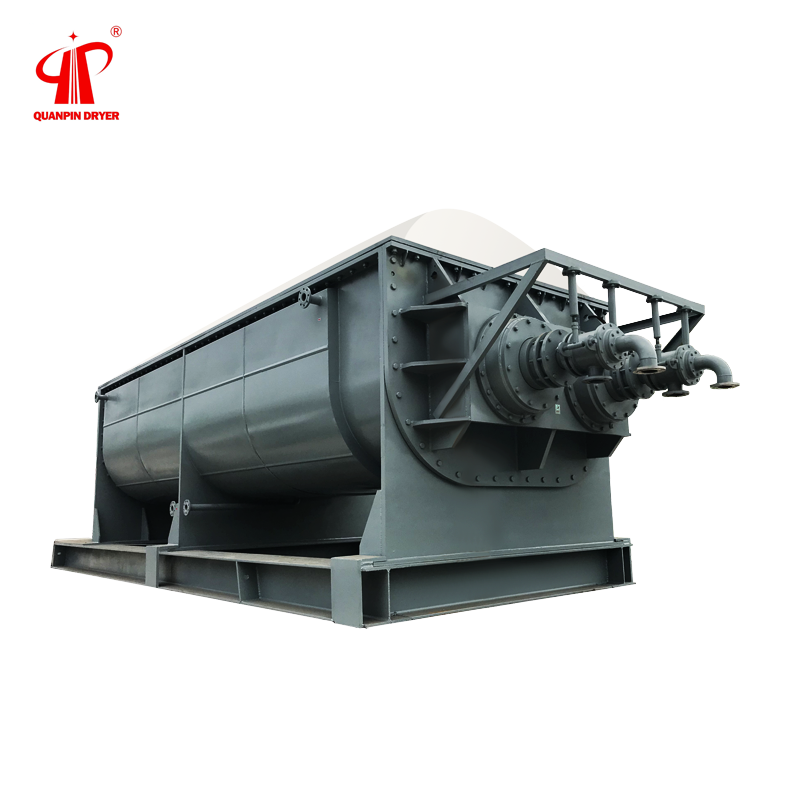
The key lies in their unique design, which offers multiple advantages. In short, through three core mechanisms—intense mixing, self-cleaning, and precise temperature control—paddle dryers overcome common challenges when processing pasty, sticky, and heat-sensitive materials.
Specifically, the reasons can be summarized as follows:
1. Unique wedge-shaped paddles: both mixing and self-cleaning
This is the most critical component. The wedge-shaped blades (resembling two slanted triangles) rotate to:
Generate strong shear force: The blade edges break up lumps, ensuring full contact between material and heated surfaces, preventing agglomeration or caking.
Provide self-cleaning: As the blades rotate, their angled surfaces create a scraping effect on the drum wall, continuously removing material that sticks to the heating surfaces. This makes the dryer highly effective for sticky, pasty materials (e.g., sludge, filter cakes) and substances prone to wall adhesion (e.g., certain resins, dyes).
2. Indirect conductive heating: gentle and efficient
Heating is achieved through hollow paddles and the jacketed shell, with no direct contact between the heat source (steam, thermal oil, etc.) and the material. Advantages include:
High thermal efficiency (80–90%) with minimal heat loss and fast drying.
Clean operation: The drying process generates almost no airflow, preventing dust emissions—ideal for toxic, odorous, or fine powdered materials (e.g., pesticides, pharmaceutical intermediates).
Easy solvent recovery: The closed system allows evaporated solvents (e.g., alcohol, toluene) to be easily recovered via a condenser.
3. Flexible process control: adapts to heat-sensitive and specialty materials
Vacuum operation: The dryer can be designed for vacuum operation, lowering boiling points and enabling low-temperature drying—perfect for heat-sensitive materials (e.g., pharmaceuticals, food, certain chemicals) to prevent degradation.
Wide temperature range: From ambient cooling (e.g., cooling soda ash) to medium-temperature drying (150–200°C for starch), and even low-temperature calcination (e.g., converting gypsum dihydrate to hemihydrate at ~120–160°C), all achievable by adjusting the heating medium temperature.
Adjustable material residence time: Paddle speed and weir height inside the shell can be adjusted, allowing residence times from minutes to hours. This ensures that whether handling high-moisture slurries or slow-reacting materials, the desired drying or reaction effect is achieved.
YANCHENG QUANPIN MACHINERY CO.. LTD
Sales Manager - Stacie Tang
MP: +86 19850785582
Tel: +86 0515-69038899
E-mail: stacie@quanpinmachine.com
WhatsAPP: 8615921493205
https://www.quanpinmachine.com/
https://quanpindrying.en.alibaba.com/
Address: Jiangsu Province, China.
Post time: Jun-08-2026